|
|

 |
Quarter-Finals:
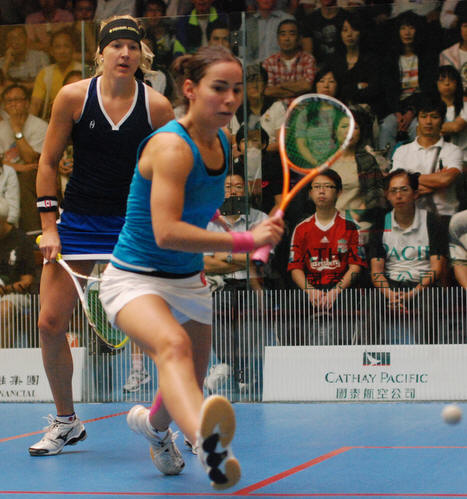
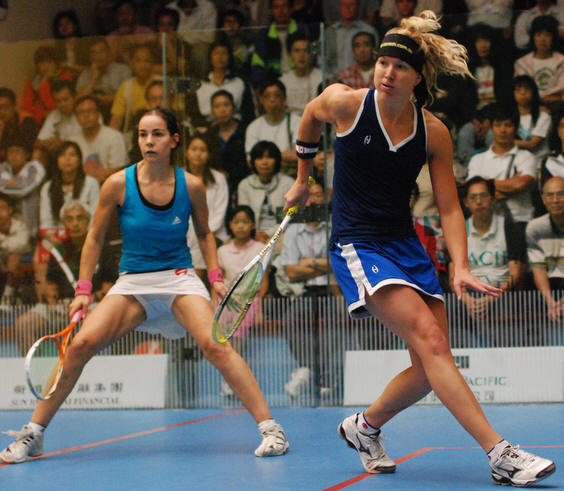
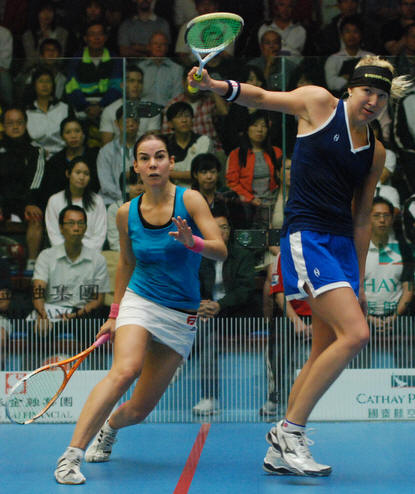
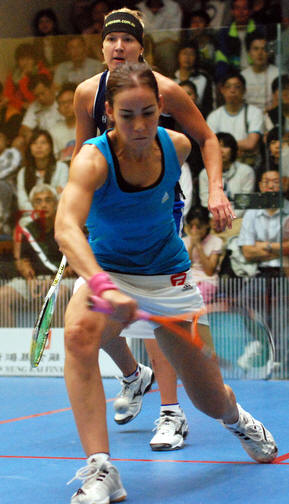
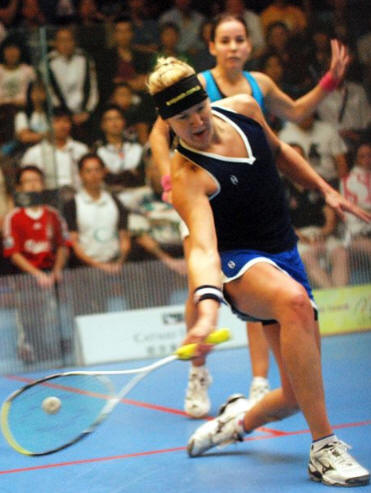
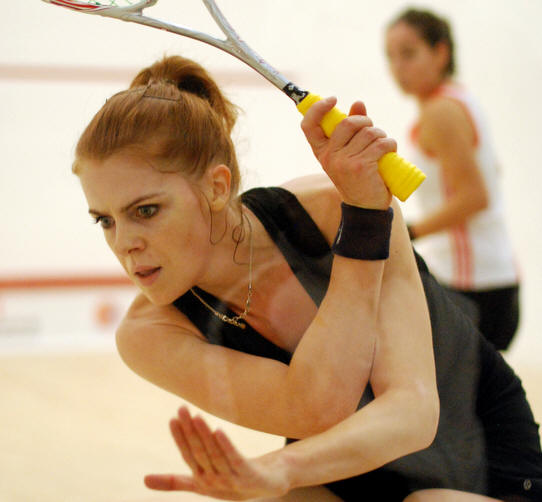
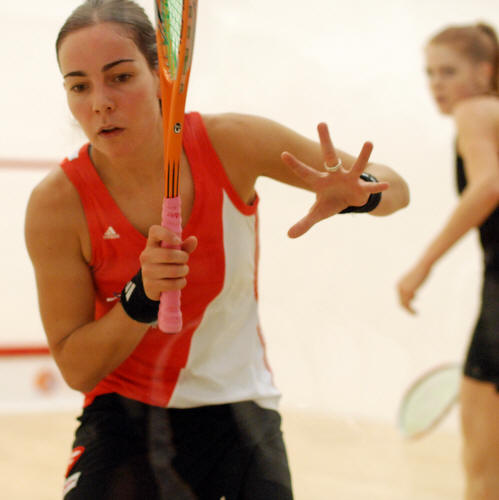
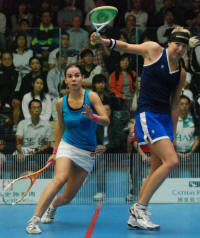
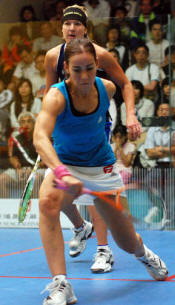
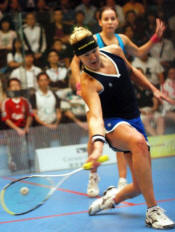
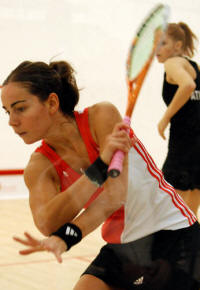
Duncalf v Brown
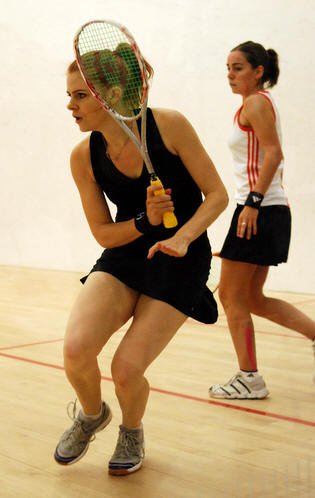
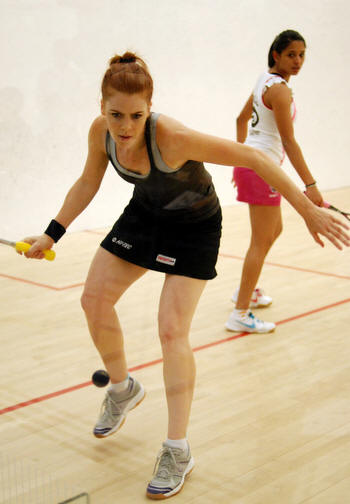
First match of quarter-finals day featured second seed Jenny
Duncalf, who played well to see off Vanessa Atkinson in the last
16, and Kasey Brown, looking fit and well, fresh from her
doubles successes in Australia.
Both girls began positively on a court that rewards attack, and
there was little in it as they played squash of quality, which
was a good advertisement for the women's game.
Duncalf, though, went ahead 6-4, 8-5 and 9-6, just having the
edge. A delayed forehand winner by brown, an error on return of
serve by Duncalf took Brown to 8-9, but Duncalf served for the
game at 10-8. Brown forced a tiebreak and another delay, this
time a backhand crosscourt, gave Brown a game ball. An anxious
let and then she won the game, slightly against the run of play,
12/10.
Two vicious forehand winners took Duncalf to 3-2 in the second,
a slip and a fall by Brown took the Englishwoman to 4-3 and she
raced to 8-3 and then 10-6. At 10-7 she hit a clever short
forehand angle which wrongfooted Brown, and they were level at
one-all.
 After
Duncalf took a 2-0 lead at the start of the third, a rally which
Brown dominated took her to 2-all. Brown moved ahead 5-3, moving
well and playing with confidence. Duncalf was back in front,
though, at 7-5, which soon became 7-all as each girl sought
control. After
Duncalf took a 2-0 lead at the start of the third, a rally which
Brown dominated took her to 2-all. Brown moved ahead 5-3, moving
well and playing with confidence. Duncalf was back in front,
though, at 7-5, which soon became 7-all as each girl sought
control.
A disruptive phase at 7-all when Duncalf was granted a let -
properly, in my view - when Brown raised a hand to draw
attention to a doubtful ball - was not a good idea. Duncalf
capitalised and as Brown made a backhand error, Duncalf served
for the game at 10-9 and took a 2-1 lead.
A fluke gave Duncalf a 3-2 lead at the start of the fourth, a
wear error by Brown made it 4-2, another crashed into the tin
for 5-2 as her concentration lapsed. She pulled herself together
however, and took a 7-6 lead.
A bold crosscourt nick off the serve by Duncalf, then a winner,
restored Duncalf's lead at 8-7. A heavy rally and Brown was 9-8,
then 10-8 for two games all. 10-9 after a Duncalf winner, a
fortunate let to Duncalf after what looked like a Brown winner,
then another tiebreak.
11-10 matchball to Duncalf, 11-all, both attacking still.
Tension of a high order. 12-11, game ball again, a quite
incredible rally which Brown dominated and won to go two games
all, an appropriate reflection of the match.
 Two
angles that surprised Duncalf helped to give Brown a 4-2 lead in
the decider. An error made it 5-2 but Duncalf recovered to 5-all
as Brown was agitated by a decision. Now 7-5 to Duncalf with
impetus. Another of those angles from Brown, 7-all. Massive
error from Brown for 8-7, stroke to Duncalf for 9-7, brilliant
straight volley for 10-7. Two
angles that surprised Duncalf helped to give Brown a 4-2 lead in
the decider. An error made it 5-2 but Duncalf recovered to 5-all
as Brown was agitated by a decision. Now 7-5 to Duncalf with
impetus. Another of those angles from Brown, 7-all. Massive
error from Brown for 8-7, stroke to Duncalf for 9-7, brilliant
straight volley for 10-7.
Brilliant forehand winner by Brown to save one match ball but a
mishit gave Duncalf her place in the semi-finals.
It was an exceptional match and gave the lie to those who doubt
women's squash - physical, attacking and combative, it was all
three of those an a lot more.
Both girls can be proud of their performance, though Brown
spoils herself with the misguided belligerence with which she
addresses the referee.
A remarkable statistic is that Duncalf reached double figures in
each of the five games - that can't happen very often.
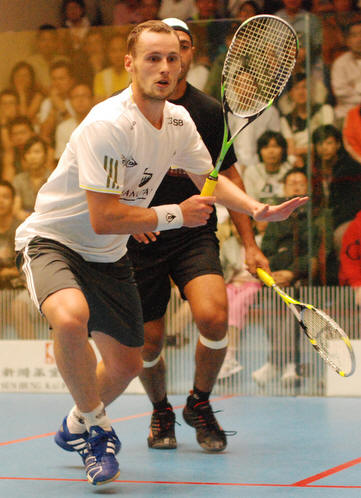
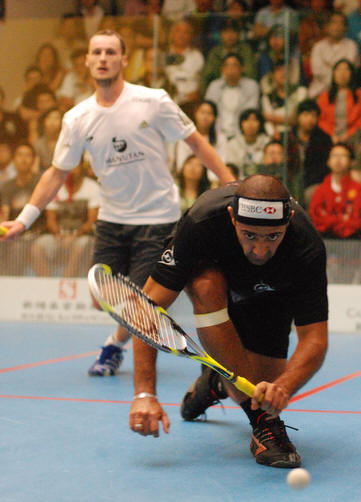
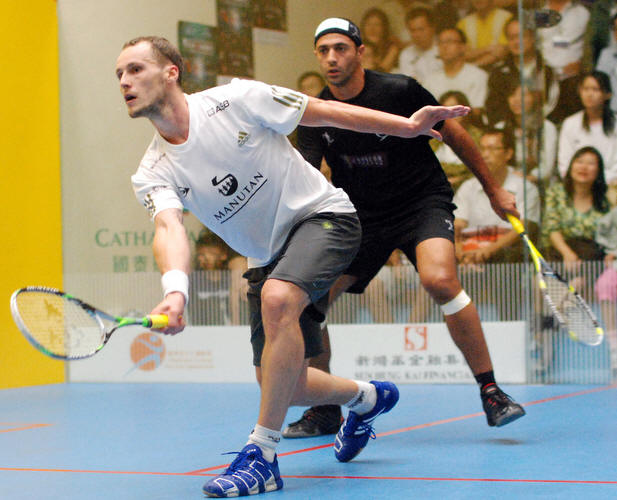
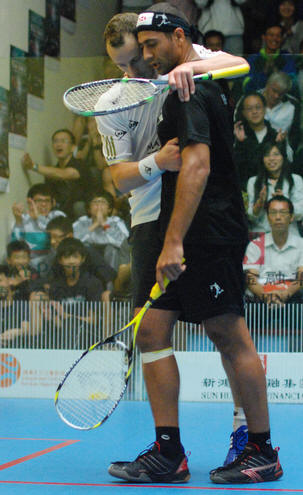
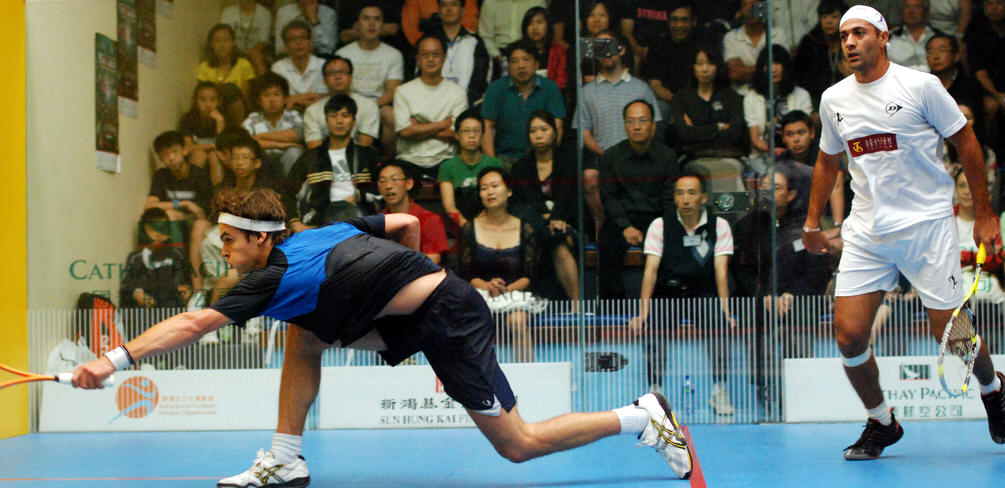
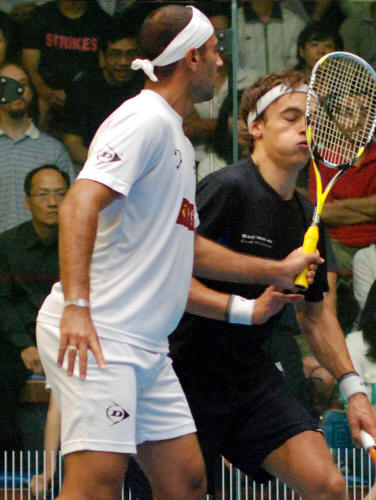
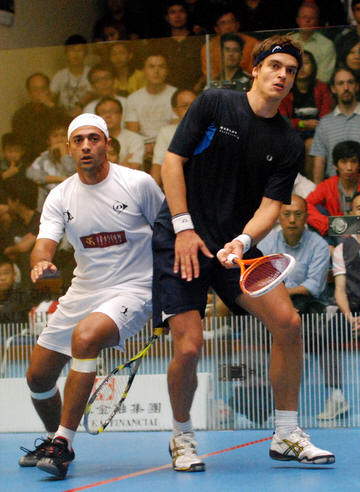
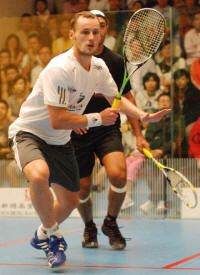
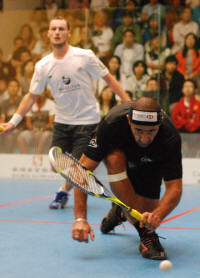
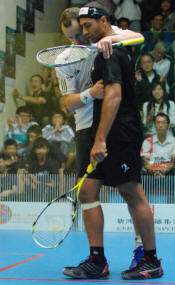
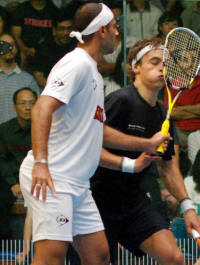
Shabana v Gaultier
After the unacceptable scenes at the end of the Barker-Matthew
match, something was needed to restore the reputation of the
world's best players and Amr Shabana and Gregory Gaultier did
that, though when Gaultier screamed maniacally towards the end
of the first game, I, for one, held my breath. However Shabana's
demeanour throughout was that of a true champion, which is what
he is.
There were spectacular winners from both players in the first
game and although Shabana led for much of it, to 9-8 in fact, a
run of four successive errors handed the game to Gaultier.
The second game followed a similar pattern - Gaultier led clear
at 5-1, but from 8-6 he produced a series of errors to hand the
game to Shabana 11/8.
The match continued at a high tempo but there was a bizarre
incident at 8-5 in the third when the referee awarded a let to
Gaultier despite his Gallic protestations that it was a stroke.
I agreed with the referee for what it's worth, but amazingly
Shabana took the decision out of the referees' hands and
conceded the point. I still don't get it!
 Gaultier
won the game 11-5, but Shabana hadn't given up the ghost and
with three brilliant winners went 4-1, then 6-2 up in the
fourth. Then the errors came, five took Gaultier to 8-7 and,
adding a couple of winners for good measure, Gaultier went to
match ball with a delightful volley drop. Gaultier
won the game 11-5, but Shabana hadn't given up the ghost and
with three brilliant winners went 4-1, then 6-2 up in the
fourth. Then the errors came, five took Gaultier to 8-7 and,
adding a couple of winners for good measure, Gaultier went to
match ball with a delightful volley drop.
He closed out the match 11-8 on a stroke.
There had been some wonderful movement and incredible rallies
and the capacity crowd roared their approval, quite rightly.
It signalled the end of Shabana's Hong Kong reign, but he lost
nothing in defeat and there are signs that he is recovering his
best form after his injury problems.
Gaultier may well feel that it's his turn now, having been close
more than once in Hong Kong. |
Round Two:
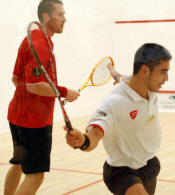
Lincou v Palmer
With these giants of the squash world approaching the twilight
of their careers - not pre-empting anything - here in Hong Kong
was a match to savour, though court 8 was perhaps not the ideal
setting.
Neither may be quite as they were in their heyday, but they are
in fine physical shape and retain athleticism.
Court 8 is not a court where dominance is apparent, but Palmer
led 7-3, having the better of things. That lead was quickly
eroded as Lincou levelled at 7-all, went in front for the first
time at 8-7, hit a fine forehand winner for 9-7 and went to 10-7
with a forehand drop. A backhand return of serve into the tin
gave Lincou a 1-0 lead, Palmer having gone 7-3 up without
winning another point.
Palmer got away again in the second, and went well clear at 9-2.
At 9-3 Lincou took a heavy fall, but was soon on his feet -
certainly quicker than today's soccer players, but this time
there was no way back for the Frenchman and Palmer levelled,
11-4.
 A
2-1 lead would be worth double, and in the third Palmer again
led, this time 6-2, having gained some comfort by working the
ball judiciously. However Lincou is famed for recoveries, and he
did, to lead 7-6, then 9-6. A
2-1 lead would be worth double, and in the third Palmer again
led, this time 6-2, having gained some comfort by working the
ball judiciously. However Lincou is famed for recoveries, and he
did, to lead 7-6, then 9-6.
A stroke to Palmer broke his barren spell, 7-8, but Lincou went
9-7 with a war-like cry that convinced his French fans that he
had hit a winner - I wasn't sure - and at 10-9 served for the
game. A stroke clinched it and Palmer will hardly believe that
twice in the match he was so far up and lost both games.
Once again Palmer led, 5-2 this time, and once again,
incredibly, Lincou reached 5-all, despite some signs of
tiredness. A demanding rally gave Lincou a 6-5 lead. Stroke to
Palmer, 6-all. Another stroke to Palmer - questionable to say
the least - 7-6.
Now 7-all as Lincou whoops after a backhand crosscourt winner.
8-7 Palmer, every rally crucial, 9-7 with a forehand straight
winner. Errors from Palmer, match ball Lincou.
A massive rally, survival or victory. Palmer tins a backhand and
the victory is Lincou's.
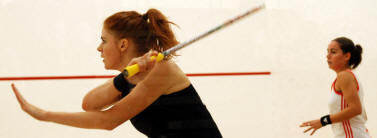
Duncalf v Atkinson
An oddity about the last 16 match between Jenny Duncalf and
Vanessa Atkinson is that English National Coach David Campion
was in Duncalf's corner and brother James Willstrop was in
Atkinson's.
A hard first rally indicated that the match would be no
formality for second seeded Duncalf, especially as Atkinson has
renewed her enthusiasm and form.
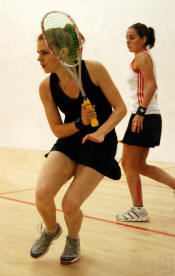 Both
girls settled quickly and the early rallies wer shaped and well
constructed. Atkinson led for the first time at 6-5, but served
out at that score. An error off the serve and a stroke took
Duncalf to 8-6 and at 10-7 she served for the first game and won
it with a lucky bounce deep in the court. Both
girls settled quickly and the early rallies wer shaped and well
constructed. Atkinson led for the first time at 6-5, but served
out at that score. An error off the serve and a stroke took
Duncalf to 8-6 and at 10-7 she served for the first game and won
it with a lucky bounce deep in the court.
Both girls were playing well, Atkinson taking the ball deep to
some effect to lead 5-2. An error put Duncalf on equal terms at
5-all, a severe rally took Atkinson to 6-5, the match at a high
level. Duncalf led again at 7-6 on a stroke. Atkinson had a
chance to go 9-all but clipped the tin with a backhand volley
drop. Duncalf took the game at the second attempt on an error
from Atkinson.
There had been little in what had been a very watchable and
quality match, and Atkinson would be feeling a little hard done
by being two-nil down.
Duncalf got away in the third to 6-1, and a stroke and an error
from Atkinson made it 8-4. Atkinson recovered well to 9-6 before
Duncalf closed out the match 11-6.
She can feel well pleased with the way she played and while
Atkinson will not be happy with the result, she should take
plenty from the performance - retrospectively, at least.
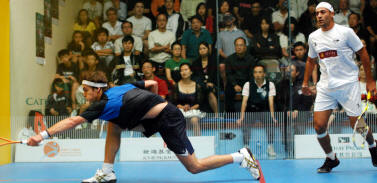
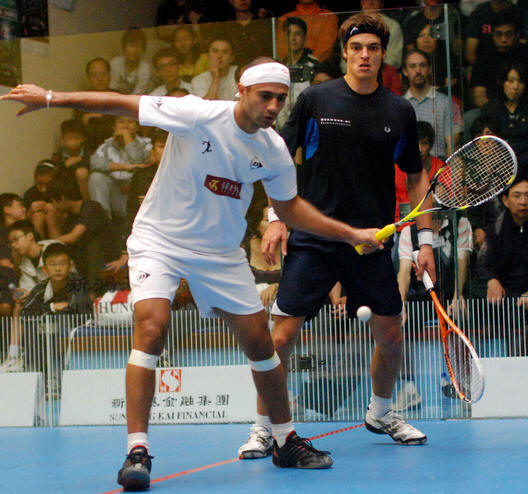
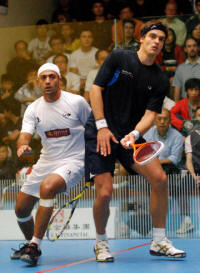
Shabana v Anjema
Amr Shabana had to stave off a determined challenge in the first
round, though he won the fifth convincingly, so it was of
interest to see what Laurens Jan Anjema might offer before a
full house.
Shabana started briskly and soon led 3-0, making the play as
Anjema worked to stay with him. 3-0 became 9-3 as Shabana hit
shots that only he can. Anjema reached 6-9, but with a
delectable forehand volley Shabana took the first 11-6, Anjema
outplayed.
 Anjema,
however, resolute and strong, led 5-2 in the second, playing
some strokes of his own, but Shabana, alert and moving well, was
having none of it and he came back to lead, 8-7, 9-7, 10-7 in
the twinkling of an eye, and at 11-7 he was two-nil up. Anjema,
however, resolute and strong, led 5-2 in the second, playing
some strokes of his own, but Shabana, alert and moving well, was
having none of it and he came back to lead, 8-7, 9-7, 10-7 in
the twinkling of an eye, and at 11-7 he was two-nil up.
Anjema led again in the third, 7-2 this time, persisting as he
does. 7-2, though, became 8-all as Shabana applied industry to
his class. A brilliant forehand kill took the champion to 9-8,
then 10-8, then to the match, 11-8.
As the match wore on, Anjema played his part, but this was
Shabana seemingly revitalised by his freedom from injury or by
Hong Kong - probably by both. Impressive, by the world's best of
recent times.
|
 |
|
|
|
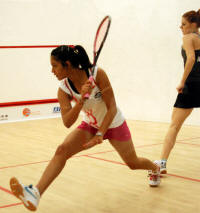
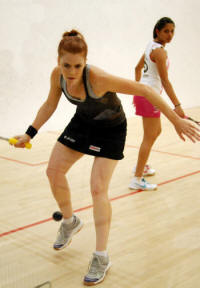
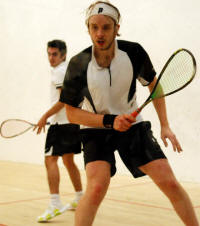
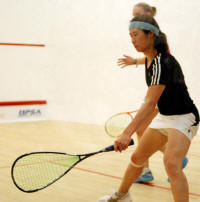
 |
Round One:
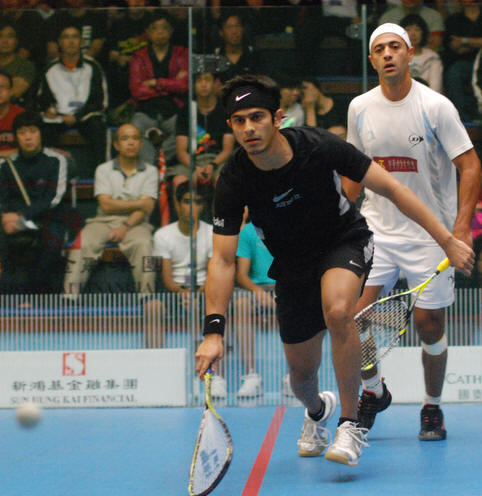
Shabana v Ghosal
Amr Shabana, playing in Hong Kong, which must seem like a second
home to him, has had knee problems which, although cleared up,
must have hindered his recent preparations.
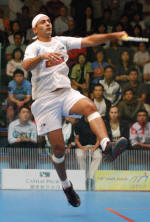 Saurav
Ghosal is a good enough player in such circumstances to prove a
threat, and that was how it turned out. Shabana won a tight
first, and restrosectively he will be glad he did, on a 14/12
tiebreak. But surprisingly he capitulated in the second, losing
it 11/3, without Ghosal having to do too much. Saurav
Ghosal is a good enough player in such circumstances to prove a
threat, and that was how it turned out. Shabana won a tight
first, and restrosectively he will be glad he did, on a 14/12
tiebreak. But surprisingly he capitulated in the second, losing
it 11/3, without Ghosal having to do too much.
The five time in a row Hong Kong champion pulled himself
together and won the third 11/8 after Ghosal had taken an early
3-0 lead, but parity was restored as Ghosal held his game
together, persisted, and was suitably eewarded.
The outcome looked in doubt: could Ghosal keep persisting? Would
Shabana's vast experience count?
In the event the fifth game was, in view of what had gone
before, a non-event. Shabana dominated from start to finish,
mostly down to his play, but in part down to Ghosal's inability
to sustain his efforts of the previous four games.
The match will have done Shabana good, but whether he can raise
his current bar to get past Nick Matthew or Gregory Gaultier has
to be in doubt.
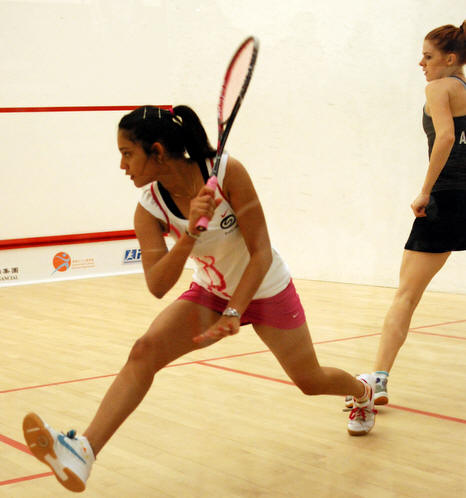
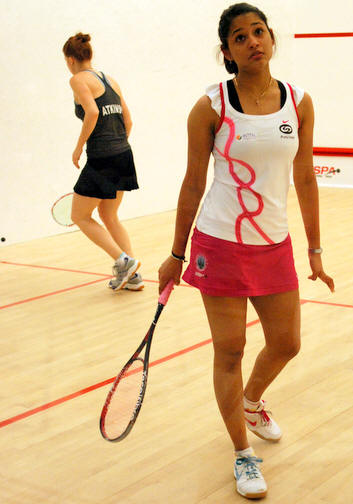
Atkinson v Pallikal
One of the fascinations of the game is to see experience pitted
against youth, and the Vanessa Atkinson - Dipika Pallikal match
epitomised this.
Pallikal has few thoughts in her mind other than attack, and
began positively, which was to be expected. Nor was Atkinson
negative, but she appreciated the need to keep the ball deep
enough in an effort to squeeze errors out of her opponent.
In truth they didn't need too much squeezing as Pallikal's error
count was high, which enabled Atkinson to win the first 11/9.
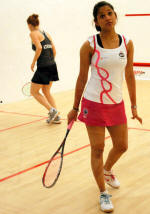 The
second game was closely fought, but after an exceptional rally
at 5-all, Pallikal began to mkae errors again and Atkinson soon
led two-nil. The
second game was closely fought, but after an exceptional rally
at 5-all, Pallikal began to mkae errors again and Atkinson soon
led two-nil.
Undeterred, Pallikal continued to attack, and with several
telling angles she controlled the third as Atkinson lost rhythm,
winning it confidently 11/6.
Atkinson rediscovered some of the rhythm which characterised the
first two games in the fourth, and took marginal control from
the middle of the game to win the game and the match, 11/7.
She should feel happy with her performance and Pallikal will be
an even greater threat to her seniors when she reduces her error
rate.
Willstrop v Khan
James Willstrop began his match with Aamir Atlas Khan as if he
had a train to catch. Despite Khan's best efforts, Willstrop
raced to a 6-0 lead, when a heavy rally did little to encourage
the Pakistani.
The first game was 11/2, and it was 9-0 in the second before
Willstrop made an error. The second game was 11/1, and as a
dispirited Khan offered minimal resistance Willstrop wonm thre
third 11/3 in less than no time.
Willstrop will be happy enough with the way he moved and hit the
ball, but he would have felt more convinced about his
performance had Khan contested more.
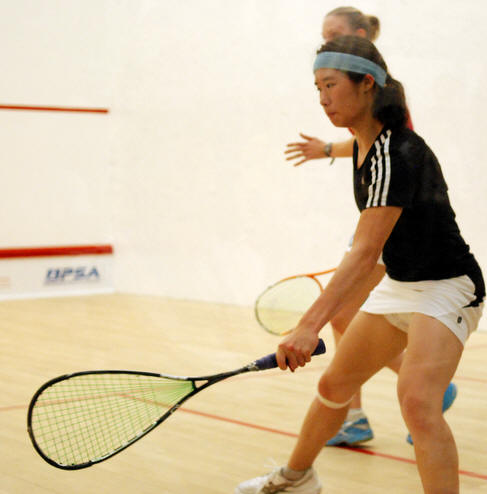
Massaro v Chan
Both girls were strapped up: Massaro's ankle and Chan's knee,
but as the first game engaged, they were moving well enough. At
8-all a winner from Massaro and an error from Chan gave the
Englishwoman a game ball at 10-8, which she took for a one-nil
lead.
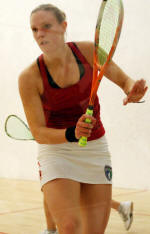 Massaro
attacked well at the beginning of the second, and led 3-0 which
became 7-2 as her confidence grew. Chan, encouraged by the large
crowd, recovered to 5-9 before a fluke in the back corner
advanced Massaro to 9-5. At 10-5 she served for the game, and
again at 10-6 as the well-ordered Chan fought hard and won it at
the third attempt to go two up. Massaro
attacked well at the beginning of the second, and led 3-0 which
became 7-2 as her confidence grew. Chan, encouraged by the large
crowd, recovered to 5-9 before a fluke in the back corner
advanced Massaro to 9-5. At 10-5 she served for the game, and
again at 10-6 as the well-ordered Chan fought hard and won it at
the third attempt to go two up.
Massaro was soon 4-0 up in the third, but there is a lot to like
about Chan's game and determination, and she fought back to lead
5-4. A stroke at 5-all restored Massaro's lead, a lovely
forehand volley and Chan was back in front at 7-6. An error by
Massaro took Chan to 8-6, then a winner to 9-6, to the crowd's
justifiable delight.
Another error from Massaro and it was game ball, then game to
Chan, who deserved credit for her fightback from 4-0 down.
Once again Massaro lead early in the fourth - this time 3-0.
Remarkably resilient, Chan drew level at 4-all. A delicately
played forehand drop took Massaro to 6-4, and gradually she
extended the lead to 9-4 as Chan still resisted. Then the
fightback - two brilliant winners and it was 7-9, then 8-9 after
a tough rally.
A forehand winner from deep gave a match ball to Massaro and she
converted with a straight backhand, delayed, which wrongfooted
Chan.
Massaro will be pleased to have progressed past such a tenacious
opponent, and Chan looks a player of high promise.
Selby v Iskandar
Doubtful if Daryl Selby or Azlan Iskandar would, either of them,
be impressed with the first round draw which saw them set up to
meet each other. Nor was it going to be easy on court 8,
whatever the outcome.
It is difficult to look good when the game resembles squash when
traditional scoring was in use, and the quality for two such
players was no more than average to begin with. But as the
players became accustomed to the demands of the court the
quality improved, with every rally of consequence since neither
was able to dominate.
 An
exquisite backhand volley took Selby to 10-8 in the first and he
won the game at the first attempt. An
exquisite backhand volley took Selby to 10-8 in the first and he
won the game at the first attempt.
Both players were doing plenty with the ball without being
sufficiently rewarded, and errors were certain to play an even
more significant part than usual, as they were not offset by
winners.
Fortified by his 1-0 lead, Selby began well in the second and
led 7-4, as lets increased, understandably enough. 7-5 became
8-5 on a stroke, 9-5 on an unforced error, 10-5 on another error
and Selby won the game with a delayed crosscourt backhand.
Two-nil looked an unassailable lead at this stage.
Doubly fortified, Selby was looking and playing with more
assurance, working the ball about as the need is on court 8, but
Iskandar hung on, eroded Selby's early lead and led 8-6. A fine
crosscourt forehand winner took Selby to 8-all. Another forehand
winner, straight this time, to 9-8 before Iskandar hit a winner
of his own for 9-all.
A crosscourt volley from Iskandar clips the tin, 10-9 match
ball, and Selby wins 3-0, a scoreline that does not do justice
to Iskandar's efforts, but is the right conclusion.
Urquhart v Hansen
Court 8 (the middle one of the three) is the most difficult of
the outside courts on which to play positively, but both Line
Hansen and Donna Urquhart started with attacking intent.
Although Urquhart looked to be having marginally the better of
things, Hansen was in contention to 9-all before the Australian
made two winning shots to take the first 11/9.
Hansen, though, started the better in the second, aided by a
couple of errors, and led 4-1, but Urquhart soon regained the
initiative and it wasn't long before she served for the game at
10-5, winning it 11/7.
Urquhart, with her slight advantage in movement and range of
shot, always seemed to have an edge, but Hansen was level at
5-all before Urquhart again asserted to 10-7, winning on her
first match ball.
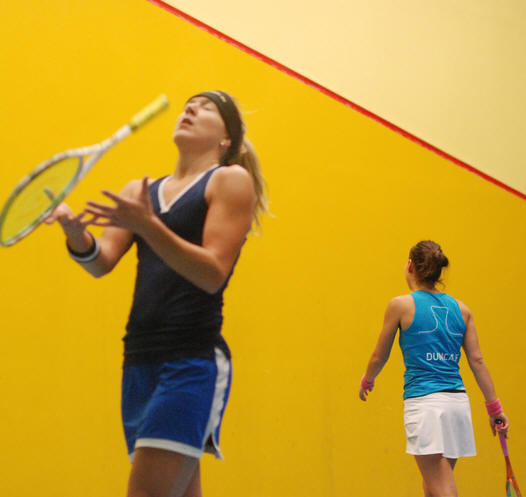
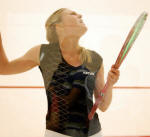 The
match was played in an excellent manner. Hardly surprising
though, that Hansen showed some disenchantment with the referee,
who warned her for throwing her racket in the air, just when I
was admiring the brilliance of the catch! The
match was played in an excellent manner. Hardly surprising
though, that Hansen showed some disenchantment with the referee,
who warned her for throwing her racket in the air, just when I
was admiring the brilliance of the catch!
How inappropriate, even stupid, was the referee's warning. |
| |
#3: Round One Preview
There have been many heavy and crucial matches in the
qualifiers, but the action will become even heavier as the
world's best move into action today.
Selby v Iskandar, Anlema v Mosaad, Ong v Pilley stand out
amongst several of these in the men's, and the women's draw is
full of interest.
On 2010 form Nick Matthew is the man to beat, but first Peter
Barker and then five-time Hong Kong champion Amr Shabana aor
three-time finalist Gregory Gaultier stand in his way to even
reach the final - that's if it all goes to plan, and that's no
certainty.
Matthew beat Ramy Ashour in a wonderful final in Canberra, the
3/0 scoreline not reflecting Ashour's contribution, and Ashour
is seeded to meet Matthew again here. James Willstrop (quarters)
and Karim Darwish (semis) lie in wait for Ashour.
It is rare nowadays for all eight seeds to reach their allotted
places in the quarter-finals, so nothing should be taken for
granted.
Matthew may be favourite to win the men's and Nicol David an
even stronger one to win the women's. Rachael Grinham, Laura
Massaro and Australian Open champion Madeline Perry are in
David's half and second seeded Jenny Duncalf will face
challenges from Alison Waters, Kasey Brown, Omneya Abdel Kawy
and others if she is to reach the final.
Men's and Women's World Tour Squash has never been more
competitive or more interesting, and what's to come in Hong Kong
will satisfy any squash enthusiast.
#2: Qualifying ...
There is something distinctly reassuring about the Hong Kong
Open: Tony, Heather, Emily, Rita, Iris, never less than
welcoming and as enthusiastic as ever, despite the longevity of
one of, if not the best, of the World Tour Championships. There
is an admirable combination of efficiency and informality about
the event that is a model for all.
The qualifying rounds are a nervous time for all involved and
defeats bring their own disappointments for the aspiring
players.
The second day of qualifying sees the raising of the bar and
there are many matches to catch the eye and some well-known
names in action: Tom Richards, Max Lee representing local
interests, American numner one Julian Illingworth, promising
Nicolas Mueller, Farhan Mehboob, Steve Coppinger, and perhaps
the best known Mohammed Abbas, amongst others.
It should be a fascinating day with so much to play for.
The women's second round looks less competitive, but there is
much Asian interest, which is good for everyone.
Today promises much, but even bigger confrontations loom
tomorrow!
Happy Birthday to Emily, one of the Hong Kong mainstays ...
#1: Good to be Back ...
A long flight, eased by the comforts of Cathay Pacific, was
further eased upon arrival at the Hong Kong Squash Centre by the
reassring sight of Tony Choi, Rita, Emily and Iris.
The longest established and most popular of the World Tour
destination remains in safe hands with Heather Deayton to add,
nor is there any reduction in enthusiasm or energy, as they
prepare for the 2010 edition.
They seem sure to be well rewarded, since the professional game
has never been stronger.
Nick Matthew and Nicol David will be hard to beat: Matthew
because of his recent dominance, David because of her
long-standing superiority.
So who are the dangers?
There are several in the men's, led by Ramy Ashour and it will
be interesting to see if the great Amr Shabana can raise his
game to Kuwait 2009 heights, pursuing a quite remarkable sixth
successive win in Hong Kong. On current form Matthew looks
guaranteed to make the semi-finals, where Shabana or Gregory
Gaultier will await.
Whatever the outcome there will be outstanding matches all
through the event. First round standouts are Daryl Selby v Azlan
Iskandar, LJ Anjema v Omar Mosaad, David Palmer v Olli Tuominen
and Cameron Pilley v Ong Beng Hee - not bad for the last 32!
Nicol David did not play in Canberra, which led to Madeline
Perry's deserved success, and Perry, Rachael Grinham and Laura
Massaro amongst others are top half opposition to David.
Jenny Duncalf did not justify her top seeding in Australia and
will be keen to justify her second seeding here. Alison Waters,
Omneya Abdel Kawy and Kasey Brown lie in wait in the bottom
half.
 |
 |
|