NICK MATTHEW:
The pain game and mind games
By ALAN THATCHER
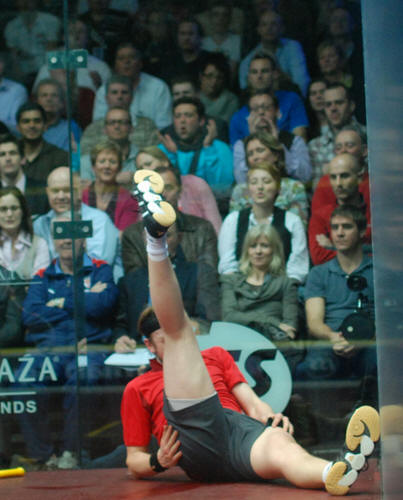
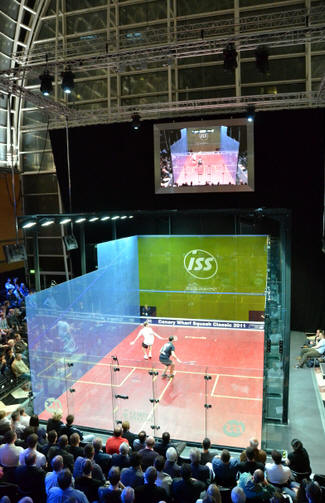
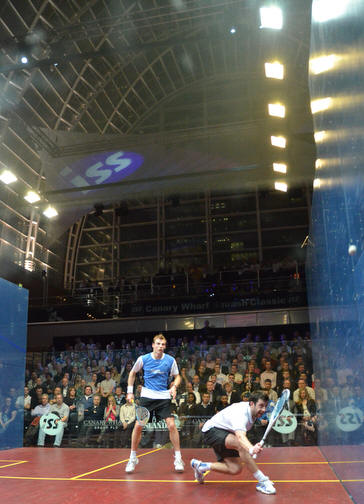
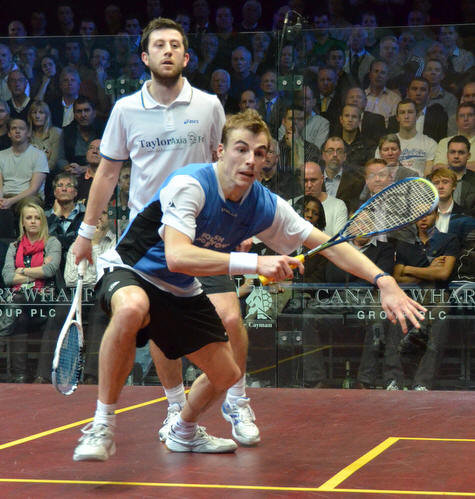
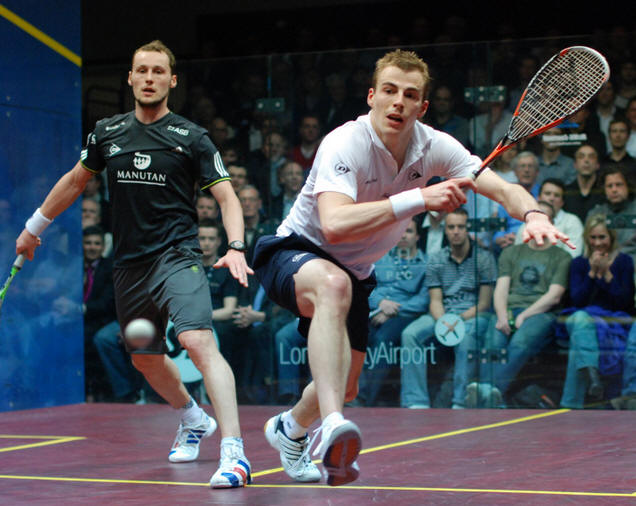
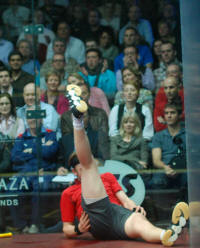
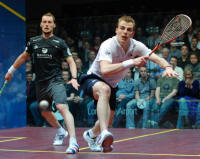
Daryl Selby dived full-length into the back right corner,
chasing down a shot from Nick Matthew as the world
champion advanced towards victory in the quarter-finals of the
ISS Canary Wharf Squash Classic.
It was a perfect length from Matthew and a spectacular dive from
Selby, more in desperation than hope, as he collided with the
side wall and ended up with his legs in the air trying to stop
his head from hitting the back wall.
 Nick
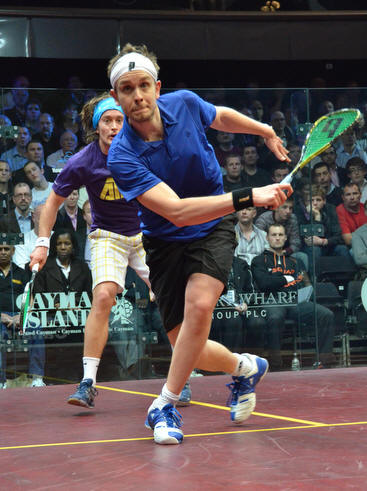
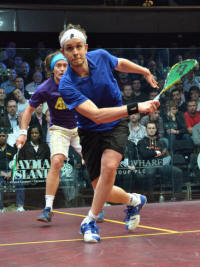
Matthew does that to people. Last year, his epic semi-final
battle with James Willstrop ended with his 6ft 4in
Yorkshire rival crumpled in a heap in the back left corner as he
dived in vain to stop a winning shot that took Matthew to match
ball after two hours and seven minutes of brutal combat. Nick
Matthew does that to people. Last year, his epic semi-final
battle with James Willstrop ended with his 6ft 4in
Yorkshire rival crumpled in a heap in the back left corner as he
dived in vain to stop a winning shot that took Matthew to match
ball after two hours and seven minutes of brutal combat.
Again, Matthew had produced a dying length, that time into the
backhand corner, and Willstrop’s spectacular attempt to retrieve
the ball was in vain as soon as he launched himself through the
air.
The fact that he suffered an acute spasm in his right thigh made
for a painful finish to the battle.
These two incidents clearly illustrate one very simple point:
that if you want to beat Nick Matthew then it’s likely to hurt.
A lot.
Going through the pain barrier is such a familiar phrase in
sport that it can sometimes sound trite, but squash players know
differently. They know the truth. Because they’ve been there,
done it, and got the bruises.
Hurting your opponents is what squash is all about, physically
and psychologically.
It’s the primal core element of our game.
Physically, you can test your own and your opponent’s bodily
resources to the limits. Psychologically, the confidence
generated by success is a constant companion of winning players.
The opposite is true for the players who lose to them, time
after time.
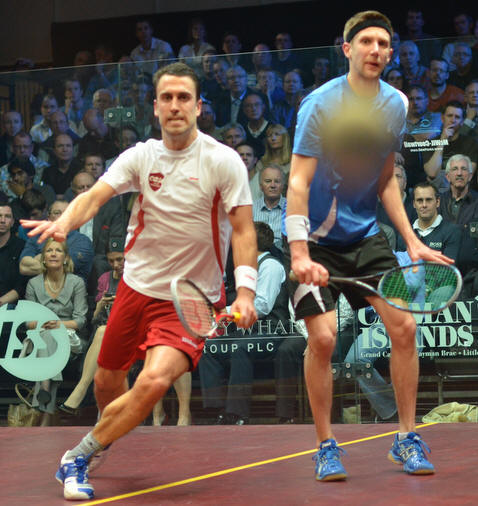
Selby entered their quarter-final full of hope after beating
Matthew in the recent National Championships in Manchester.
Matthew knew that, and treated his opponent with the respect he
deserved, despite his comments after the game that Selby was
like a gnat. “You keep swatting him away but he keeps coming
back for more.”
Willstrop must be wondering what kind of game plan he has to
employ and execute to beat his Yorkshire rival. Their Head to
Head series reveals a long, uninterrupted line of victories to
Matthew.
Tonight, a resurgent Gregory Gaultier faces Matthew in
the semi-finals at Canary Wharf.
It is a fascinating, compelling re-run of last year’s final,
when Gaultier was unable to exploit any weaknesses Matthew may
have felt following on from his marathon semi-final against
Willstrop.
In the other half of the draw, Willstrop will be in the
psychological ascendancy with an unbeaten career record against
his opponent, Peter Barker.
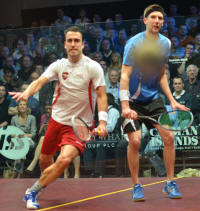 After
Barker had battled past Stewart Boswell in the
quarter-finals, clinching a dramatic tiebreak 17-15 in the
fourth game after 88 minutes of ferocious combat, I interviewed
him at courtside and somewhat brutally, I must admit, stated the
fact that if he wishes to improve on his current ranking then he
needs to start winning tournaments like this. After
Barker had battled past Stewart Boswell in the
quarter-finals, clinching a dramatic tiebreak 17-15 in the
fourth game after 88 minutes of ferocious combat, I interviewed
him at courtside and somewhat brutally, I must admit, stated the
fact that if he wishes to improve on his current ranking then he
needs to start winning tournaments like this.
“Thanks for that, Thatch,” he replied. “But believe me, I don’t
enter tournaments like this wanting to go home after the
quarter-finals or semis, I want to win them.
But there are six extremely talented, tremendous players ahead
of me in the world rankings and to climb above them requires
some massive results.”
I recall interviewing Thierry Lincou on a bitterly cold
winter’s day in Times Square in New York during the Tournament
of Champions at Grand Central Station in 2003.
He was due to play Jonathon Power in the quarter-finals
and revealed that he had never beaten him before.
He admitted that it was a huge psychological barrier and one he
needed to break to through to help him reach his short and
long-term career goals.
Lincou was improving steadily and, one by one, was beating the
guys ahead of him in the rankings. He had beaten most of them,
apart from Power.
The Canadian had the game to chop you up and destroy your
confidence in the process. He could sense a weakness and exploit
it, time after time, especially when he held his shots and
forced an opponent to guess where the ball was going before he
played the ball.
You can probably guess the rest. Lincou fought back from two
games down and achieved his first victory over Power. He went on
to reach the final but lost to Peter Nicol. That barrier
had to wait another year or two before Lincou pushed his way
through.
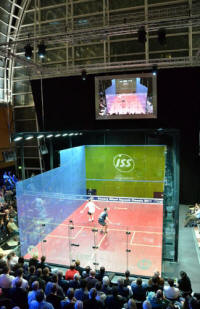 I
wonder if Gaultier can follow his compatriot’s lead and knock
down some of his own mental barriers this week. I
wonder if Gaultier can follow his compatriot’s lead and knock
down some of his own mental barriers this week.
After all, he held the world No.1 ranking spot 15 months ago but
suffered an acute stress reaction to being there.
Matthew seems to thrive on the competition but had demons of his
own to fight in the recent North American Open in Richmond. He
managed to sweep those aside to beat Ramy Ashour in a
superb final to maintain his hold on the No.1 spot in the
rankings.
The next two days will, I am sure, produce three outstanding
squash matches on the way to deciding this year’s Canary Wharf
champion.
The outcome will be settled as much by the mind games as the
squash games.
And yes, it’s going to hurt.
|
Follow Alan on
the CW BLOG

Follow Alan on
the CW BLOG |