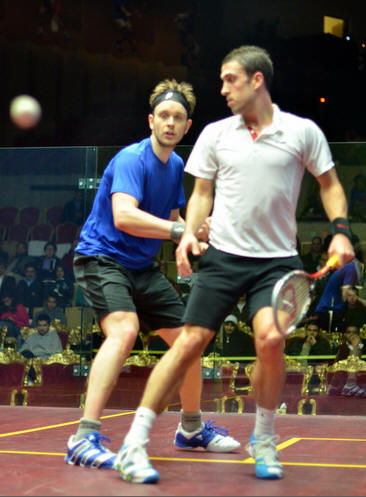
Quarter-Finals:
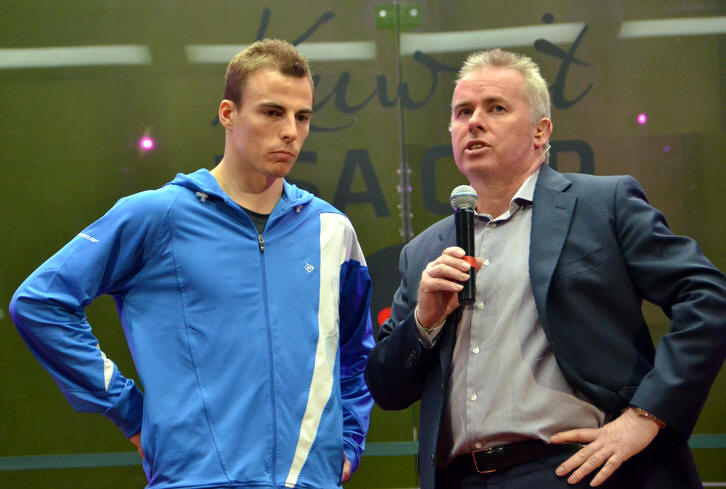
The world champion
hopes to rescue his season
Richard Eaton
World champion Nick Matthew admits his season may be over
after pulling out of the quarter-finals with an adductor muscle
injury he has been hiding for a long time.
The 31-year-old Englishman hopes to recover before the last
World Series tournament of 2011, the Punj Lloyd PSA Masters in a
fortnight’s time in Delhi but acknowledges there is a risk he
may not make it.
“It is possible the season is over for me. But I have a
fantastic team and I hope that with the right assessment and the
right treatment I it may heal,” said Matthew, who even had the
problem before retaining the World Open title in Rotterdam three
weeks ago.
His decision to allow his opponent, Karim Darwish, the
former world number one from Egypt, to go through to the
semi-finals was taken just ten minutes before they were due to
go on court.
“When you have an injury you get used to emptying your mind and
doing your preparation exactly as usual,” Matthew explained.
“But the muscle felt like it might snap when I lunged, and if
that happened I could be out for a long time. I’m very
disappointed but if I played I’d risk kissing goodbye to a great
deal more.”
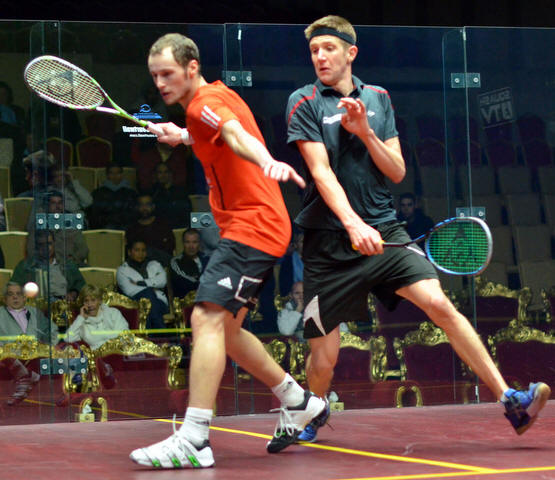
Earlier Greg Gaultier, the former world number one from
France, criticised the new draw system after becoming the first
player into the semi-finals by beating Stewart Boswell 8-11,
11-5, 11-2, 11-5 he also brought an end to the Australian’s
career, before offering his opinions in characteristically
forthright fashion.
“I don’t think it’s a good thing,” Gaultier said of the
experimental quarter-final redraw which pitched top-seeded
Matthew and second seeded Darwish against each other.
The aim is to generate more media interest with more
unpredictable outcomes, but Gaultier thinks the cost outweighs
the benefit.
“Do you want to see Djokovic and Nadal play early on in a
tournament? I don’t think so. If the players lower down want to
get to the final they should have to beat me, or one of the top
four," he said.
“The top players have to work hard all year to get where they
are, and if then they have to play each other in the
quarter-finals they don’t get the reward for they have done."
Doubts about Gaultier’s ability to overcome Boswell lasted
longer than expected after he unaccountably let slip an 8-5 lead
with a flurry of errors. But from the second game onwards he
volleyed adventurously and gained reward in cold conditions for
his clever changes of direction and his ability to play the ball
tight when he went short.
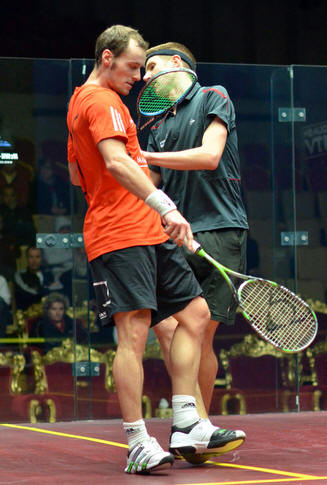
There were two moments of tension – one when the match was
interrupted to get some purple lights turned off, and another
when Gaultier exploded at the referee for allowing Boswell to
halt a rally and leave the court with a broken a string.
“Hey, hey, he can’t do that,” bellowed Gaultier, looking as if
he might chase after his opponent and pull him back. “He broke
his strings - he has to keep playing!”
However the let decision had actually been awarded because the
referee decided there was interference to Boswell’s path to the
ball during the rally.
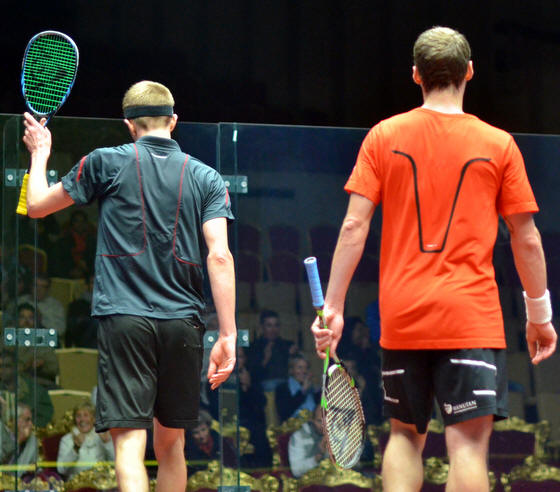
It was a sharp and sudden end to the career of the likeable
Aussie, who was too emotional to talk, instead leaving a written
message thanking his coaches, family and wife, Vicki Botwright,
the former World Open finalist from England, with whom he has a
son.
The 33-year-old from Canberra reached a career high of world
number four, captured the world doubles title with Anthony
Ricketts, and won the Australian Open three times.
He might have achieved more with his disciplined and
well-drilled game but for a back problem which sidelined him for
two years. His comeback since 2005, requiring much courage and
persistence, was also a considerable achievement, if sometimes
less well recognised.
Gaultier now plays James Willstrop, the winner of last
week’s World Series event in Hong Kong, who beat compatriot
Peter Barker, a fellow member of England’s world title winning
team of 2007, in straight games; Darwish faces his compatriot
Mohamed El Shorbagy, who beat Laurens Jan Anjema, the
leading Dutchman, in four games.
It is testimony to the growing depth of the top level game that,
even without the world’s two top ranked players, the semi-final
line-ups still look so attractive.
 |




 |