|
|
|
[ Up ] [ Willstrop ] [ Roundup ] |
|
Malcolm Willstrop on the semi-finals: |
It is sometimes difficult for players to back up major wins,
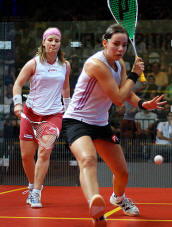
which is what Jenny Duncalf's over Rachael Grinham certainly
was.
With more expectation on her shoulders, Duncalf started
tentatively against the in-form Isabelle Stoehr. The
incisiveness which characterised her win over the world
champion was not there and Stoehr capitalised, converting a
5/1 lead into 9/4.
Settling better, Duncalf took the initiative in the second
game, led 6/1 and won the game comfortable 9/3. She went
clear again in the third, but the Frenchwoman resisted
determinedly before Duncalf won it 9/6.
The fourth was similar with Stoehr battling all the way
until Duncalf clinched the match 9/6. To her credit she had
ground out a win without reaching the previous day's dizzy
heights. Players have to learn the art of winning when they
are not at their best or when things are not going their
way. Duncalf did that against a spirited opponent.
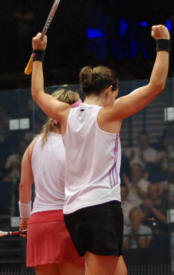
She will, on reflection, e thrilled, as indeed she said she
was, to reach the British Open final. She would have settled
for that at the beginning of the event.
The match, by the way, was further proof of the need for 11
scoring for the women's game.
David Palmer had, despite winning, made uncharacteristic
errors in his match against Amr Shabana, but taking the
first against Karim Darwish, they were hardly in evidence.
But they reappeared in the second as Darwish gathered
confidence, took control and won it to level the score.
Playing freely now, with the racket skill everyone knows he
has, he moved easily to 8-3 when he slipped in the front
left, buckled and went down heavily.
The signs, as he received treatment, were not good, and a
quick trial movement on his return to the court told him all
he needed to know. He conceded and understandably cast his
racket down in frustration.
You could only feel for him, but it meant that Palmer's
dream of a fourth win remains very much alive.

|
 |
|
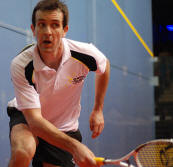
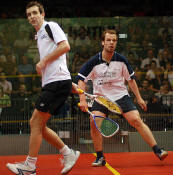
David Campion |
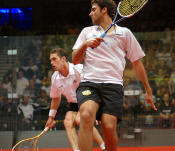
A considerable personal
pleasure for me was to have David Campion featuring on
semi-finals day at the Echo Arena.
Having coached him from the first time he hit a squash all
at the age of 7, having predicted that he would play for
England after his first lesson, it was rewarding to see his
unusual gifts with a racket again.
Belonging to the golden England era of Peter Marshall, Simon
Parke and himself, he reached the final of the World U19 in
Paderborn, beat several world top 20 players immediately,
but injuries prevented him from fulfilling wwhat was certain
to be a successful playing career.
Happily coaching has become his life and he is a key member
o England's coaching staff. Nevertheless it was good to see
him back on a big stage and good for many people who have
never seen his talent. His touch, easy racket and subtlety
set him apart from the ordinary.
His post-match interview emphasised, to, his ability to
speak lucidly about the game he clearly loves.
He beat Simon Frenz of Germany 3/0 in some style and it will
be good to watch him in action again in the final against
Steve Richardson.
|
 |
|
|