|
|
|
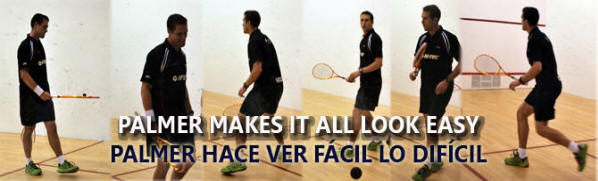
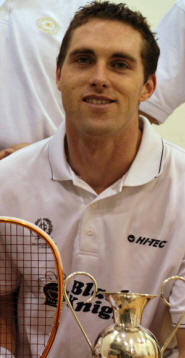
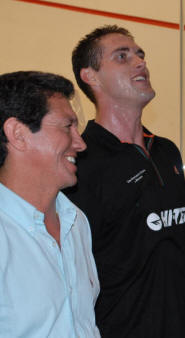
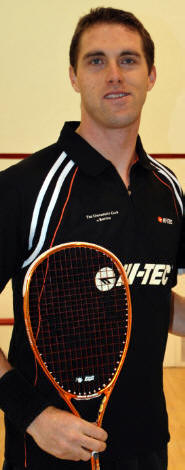
Part One - David Palmer in Colombia
Colombian
Open |
 The
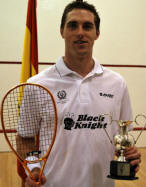
32 year old Australian David Palmer is a true legend
of modern squash with four British Open titles, two world
titles and 50 PSA final followed by 24 professional titles,
No.1 player in the world and nothing less than one hundred
months in the top ten players in the world, successes that
are very difficult to achieve by any player in the following
years. The
32 year old Australian David Palmer is a true legend
of modern squash with four British Open titles, two world
titles and 50 PSA final followed by 24 professional titles,
No.1 player in the world and nothing less than one hundred
months in the top ten players in the world, successes that
are very difficult to achieve by any player in the following
years.
Palmer is not only a successful player, but he has an
enormous conceptual clarity of the sport, discipline,
dedication and perseverance due to his clear objectives that
allow him to be known as a professional in its maximum
degree. This clarity and seriousness of his ideas and
concepts are showed in the same effectiveness off the court.
He is direct, sincere, open and reserved with his personal
life.
 Characterized
by his firm convictions, Palmer lives in Boston with his
wife and two daughters that are his biggest motivation. His
young daughters Kayla, 3, and Miley who is only a month old,
are his inspiration. Characterized
by his firm convictions, Palmer lives in Boston with his
wife and two daughters that are his biggest motivation. His
young daughters Kayla, 3, and Miley who is only a month old,
are his inspiration.
His face remembers them and sustains
that it’s difficult for him to be away from his three women
for a long time, but nonetheless he is aware that the time
he spends with them is more valuable than that of a persona
that goes to the office every day.
“The quality time I dedicate to them is the most important
thing,” he says, but emphasizes that he wishes he had more
time for this family.
He assures that Kayla and Miley will play squash, and
although he doesn’t see them as professional players in the
future, if they wish to he will support them unconditionally
because he says, “sports are a way of becoming a better
person.”
|

Interview and Article by Juan Carlos Santacruz

“When the hunger to win ends, it’s time to stop.”
“I’ve been lucky because I have been in the right place in
the right time.”
“My greatest challenge today is maintaining my speed on
court.”
“Players should be clear about the way they train, because
it is the way they compete.”
“You train the way you want to play and therefore its
possible to play like you have trained.”
“The key to playing in altitude is not to panic.”
“Fast courts don’t allow a proper technical development.”
“You have to cheer up, and leave home to achieve success in
sports.”
 |
THE BEGINNINGS
Palmer began to play squash in his country Australia at the
age of 5. His parents introduced him to the sport because
they too practiced it. Australia has been a squash power
since the late 1960’s.
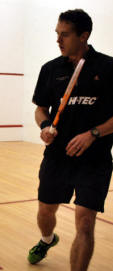 He
turned pro at the age of 17 and by 1995 he conquered his
first junior title in the category U-19. By this time, he
was already No.69 in the PSA ranking and his outstanding
career began and he reached the top places due to his
professionalism, and he has become one of the most important
symbols of the decade. He
turned pro at the age of 17 and by 1995 he conquered his
first junior title in the category U-19. By this time, he
was already No.69 in the PSA ranking and his outstanding
career began and he reached the top places due to his
professionalism, and he has become one of the most important
symbols of the decade.
Palmer’s debut as a professional was in 1994 and in the year
2000 he entered the most exclusive group of the best top ten
players in the world, since then he has always maintained
his place in this group, being the only player in the world
with the most enviable record, more than 100 months in the
top ten.
He has been a professional for 15 years, maintaining himself
in parallel to the young promises of the future. Therefore
it is impossible not to ask when he plans to retire. Palmer
is categorical when he ensures that his retirement will only
come when he has completely lost his passion to win and
today remains intact.
“That’s the only time to stop,” he sustains and affirms that
his aspiration is to at least continue to be a professional
until 2010, but if he continues in the top ten he can think
about it one more time. |
|
 |
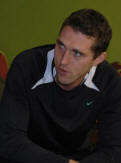 What
is the secret to becoming one of the best players in the
world? What
is the secret to becoming one of the best players in the
world?
Hard work, good trainers and luck, to be in the right place
at the right time.
How to maintain a top level through the years?
Consistency and training. It’s not easy, but you have to be
smart. It’s not about long hours of training, but the
quality of specific programs. I have discovered with my age
that you don’t have to train too much, not like before. It’s
important to adjust times strategically and have quality
routines.
I have sustained my level after 30 years due to my training
and preparation; I have had few injuries and I have obtained
a lot of experience. I keep myself strong and focused and
today my greatest challenge is to keep my speed on court.
Those are the key elements for success.
How do you train?
I have managed to learn how to train with quality. That is
the key. It’s better to dedicate 30 minutes of 100% effort,
than 2 hours with 70% effort. I have seen many players that
don’t train adequately and then want to play correctly.
Players should be clear about the way they train, because it
is the way they compete.
How do you train correctly?
You have to establish goals for every training session.
Squash is based on repetitions and muscular memory. You have
to repeat every single shot one thousand times to make it
more precise. You train the way you want to play and
therefore it’s possible to play like you have trained. In a
9-9 score in a fifth game you can only respond to a serve
with a cross court nick shot if you have the confidence. If
you trained it, you will do it with no hesitation.
Why did you decide to come to Bogota?
My objective is to try to win the US Open in Chicago the
first week of September and after, conquer another British
Open title in Manchester in the second week of September.
When I was checking the calendar I thought the altitude of
Bogota would benefit my endurance for the following
tournaments.
What do you think about altitude here and the way to play
with it?
An athlete should be prepared for any kind of conditions and
challenges. Nonetheless it would have been ideal to reach
Bogota one week earlier. Yet, it all depends on the way you
confront it mentally. Everybody is affected in different
ways, but it’s inevitable that you lose your breath once in
a while. The only way to open a path to success is the way
in which you handle his moments in your head.
The moment you are out of breath, have a headache, tension
in your chest and your stomach hurts you shouldn’t panic.
When you feel tired, you instinctively start to kill the
ball, but it’s not the best exit. You have to understand
that the sensation is temporal and it’s better to lower the
pace, metalize and seek for energy to continue. It you are
well prepared you will get through it.
What do you think of South American players? Do they
have a chance of entering the exclusive group of the top
ten?
South America has great players, but very few. This is
because of the courts in which they play in; they are not
the same courts as in the biggest tournaments in the world.
The courts are very fast; the ball bounces too much and even
slides. These characteristics are an impediment to develop a
proper technique.
You can’t truly appreciate a good shot in these courts. Here
you play low shots rather than long and precise shots. This
is why good fast- court players have great difficulty to
show their potential on cold courts that are slower and they
can feel frustrated when they play in them.
What type of courts should we have?
The characteristics should be different. Floors should be
soft and not hard like most courts. They should be colder
with the use of air conditioners and the walls shouldn’t be
shinny, like the courts we are looking at. If the courts had
these conditions, the players that train in these courts
shouldn’t have a rough time in other courts around the
world.
I’m convinced that this scenario would allow Latin American
squash to become more competitive. For example look at Borja
Golan. He has been able to enter the privileged group of the
best players in the world because he has trained the
technical abilities that he lacked before. But additionally
to training in cold and slow courts, players that have
professional aspirations should leave home and train in
Europe. You have to cheer up and leave home. This truly
guarantees success.
Do you consider yourself a rich man after 15 years of
playing at top level?
Honestly, I have managed to live comfortably but I have
always paid things by myself. I have never received any
support from any institution or government organization. I
have paid everything by myself and have obtained everything
I have thanks to my dedication and effort. I admire those
players who have support from their countries. They should
take advantage of it, I never had it.
What will you do after you retire?
I have two options. Stay in the USA as a coach or return to
Australia and start up an academy of squash. I will have to
analyze each option when the time comes. |
THE
GOODBYE
This conversation is reaching its end and we wish we had
more time. His words are overwhelming as well as his
presence and conceptual clarity. He says goodbye with
signature kindness and raises the athletic figure that
identifies him thanks to his stature and tapping the tips of
his shoes when he walks, just like he does on court before
serving.
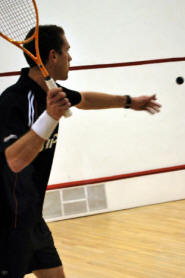
His size and muscle structure are intimidating on court.
Everyone, from his rivals or the people around him, think
how to surpass him. On court, he plays with admiring
easiness, flexibility and surprising speed.
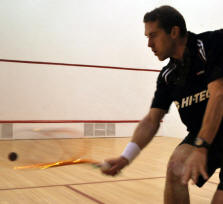
All his shots look easy because he makes that which is
evidently hard look simple. This is the greatest asset of
champions.
 |
 |
|


