30-Mar-09: Squash and the Olympics - the
next step
There is little time to rest for New Zealander Susie
Simcock as the bid continues for squash to be included
in the 2016 Olympic Games.
The World Squash Federation's Emeritus President has just
returned from the United States, where she has been on the
campaign trail at SportAccord in Denver. However, the
stop in Auckland has been short lived, with barely enough
time to re-pack her bag before whistling off to Wellington.
Ms Simcock will attend a Parliamentary reception for IOC
President Jacques Rogge tonight. The reception will be
hosted by New Zealand Prime Minister John Key, himself a
former top squash player. Mr Rogge is in New Zealand for
this week's Oceania Olympic Committee (ONOC) General
Assembly in Queenstown.
Seven sports are vying for two spots available at the 2016
Games, with Squash, Golf, Rugby, Roller Sport, Softball and
Baseball on the shortlist.
The squash fraternity has lobbied long and hard after
missing out on the vote for the 2012 Games, with
administrators and players united in the belief that the
sport is a perfect fit for the Olympics.
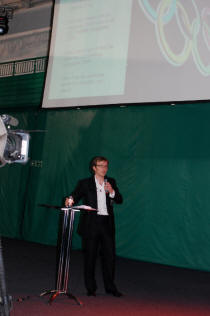
They will get their chance to state their case yet again in
Queenstown tomorrow, when the rival sports will all give
presentations at the ONOC general assembly. WSF Vice
President Gerard de Courcy, also a New Zealander,
will present the case for squash, with Susie Simcock and
Oceania Squash President Col Clapper in support.
Representatives of the Tokyo, Rio de Janeiro, Chicago and
Madrid bids will also make presentations, ahead of voting
for the 2016 hosting rights later this year.
19-Mar-09: Squash will take
the Olympics
into new markets ... Richard Eaton reports
Squash would take the Olympics into new markets if it were
to succeed in getting into the 2016 Games, according to one
of its all-time greats, Peter Nicol, who won four
Commonwealth gold medals and was world number one for a
total of 60 months - but was denied the chance to play in an
Olympics.
The sport-in-a-room should score heavily in the votes to be
announced in October because it is well represented in
developing parts of the world, and in Asia, and among Muslim
women, says Nicol, who is an ambassador for his sport's bid
and was making a presentation at the
ATCO Super Series
finals at Queens Club.
“Represented
among the top players in the world there is a huge variety
of countries not necessarily going to be in the top part of
the Olympic medal table.
“Nicol David has been world number one for nearly three
years and could win a gold medal for Malaysia which would be
the first Olympic gold Malaysia has won.
“Egypt currently has three men in the world's top four, and
Mexico has Samantha Teran who is highly ranked now.
“We have got players from all over the world achieving great
things in squash, which is appealing to the Olympic
movement.
“We can take the Olympics into new markets, and the Games
would do the same for us. Countries not well represented in
the medal charts would succeed.”
Squash also considers its
strengths to be maximum impact at minimal cost. It can place
a portable court at any venue in almost any place, and
especially where there is a spectacular backdrop, attracting
television and enhancing a city's profile.
It is also economical, leaves no waste, and will create a
legacy of courts to the host country, Nicol pointed out.
Squash's long-term weakness, not televising well, has been
largely eradicated by new technology which makes the ball
much more visible. It can also claim to be one of the
healthiest of sports and would offer the organisational
advantage of having minimal athlete numbers at the Games.
It was also the new sport which got the closest to inclusion
for the London 2012 Games. However it faces tougher
competition this time from six sports – golf, baseball,
softball, rugby sevens, karate, and rollers sports.
A decision on which of these sports should occupy two places
available for 2016 will be made in Copenhagen in October.


 19-Mar-09: