"Hip op’ done and dusted now the physio is
calling the tune"
says James Willstrop
"I’ve been off the feet for the last month after
hip surgery in September, and mobility has been limited.
Any venturing into the big wide world tends to be challenging but pleasant
enough. Crutches are helpful props: people stand aside and offer spare seats on
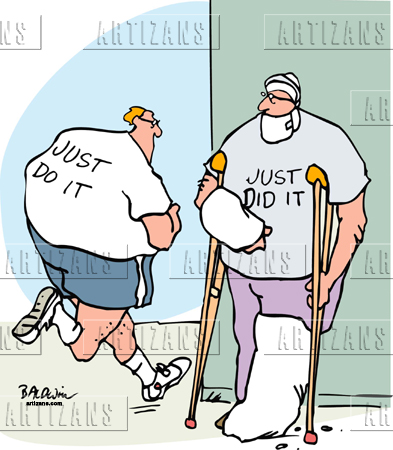
buses and I’ve been offered discounts even in cafés. I was asked if I needed a
wheelchair once and many enquire with a grimace before kindly sympathising.
Inquisitive types state furtively that they thought hip operations were for old
people. This makes me feel so much better and so much worse, and I respond that
I’m only getting what I deserve after a lifetime playing a stupidly hard sport.
I'M A BIG UNIT...
Sport takes a toll on the body, squash more than most. I’ve learnt recently that
I’ve done mine some damage and the unfettered pliability I had as a 21-year-old
might not be realisable in the same way again. I’m a big unit, lugging 20 kilos
more than most players with every movement I make: solid weight going through
the body hundreds of times every week over 25 years and it’s clear to see why
there are creaks.
I aspire to be a professional player once more, but long-term preservation needs
to be considered, so rehabilitation and training will have to be more careful
and subtle now.
WATCHING THE OTHERS PLAY...
I’ve been watching bits of the US Open, wincing as the players bound around the
court, hammering their bodies into the ground. I know I’m not the only one, all
full-time squash players will have some degree of joint damage that could have
implications in the future.
Many squash players have retired early: Chris Robertson and my brother
David Campion, England’s national coaches, both had career-ending hip
issues. Jonah Barrington had hip replacements, and more recently
Anthony Ricketts and Lee Beachill had knee injuries which curtailed their
careers, and they were both younger than I am now.
BEING LOOKED AFTER...
It’s tricky ground but I have a highly regarded hip surgeon Max Fehily
looking after me, and I’m so fortunate to have my physio Alison Rose
behind the rehabilitation process every step of the way. Mark Campbell,
my conditioning coach, is at some stage faced with getting me back into the gym
and fit. I must mention Vanessa too who now has two babies to look after,
wash and dress each morning.
The first four weeks have been restful. Prof Fehily repaired a tear of
the labrum (the fibrous rim of cartilage around the hip joint that keeps the
head of the femur in the socket and functioning normally) and cleaned up mess
around the joint, causing some trauma which needs to heal.
WSA
player Joelle King recently posted a photo of her legs after an
operation she had in August. The muscle wastage on her operated leg is drastic;
we are so used to using the muscles in the legs to such extremes they quickly
deteriorate when we don’t.
To counter this as much as possible, Alison had me doing basic rehabilitation
from the first week. Low level leg extensions and basic Pilates on the floor
added to gentle mobility work was all that was necessary at that stage.
Joelle potentially has much longer to sit out than I have, having ruptured her
Achilles, but muscle decline through inactivity is still an issue, so I use a
compex machine every evening to prevent this as much as possible. Sticking wired
electrode pads onto the muscles, I simply sit and let the electrodes send
impulses which fire the muscles I need to stay strong. It’s no substitute for
real training, but can help.
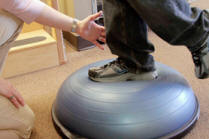
By week three Alison allowed me time in the pool. The first thing
I could do was swim a little with arms only, which at least quickened the heart.
The weight of the water enables me to practice walking, squatting, lunging and
calf-strengthening. It is helpful that the body feels the sensations without the
weight going through it. This type of proprioception work, through which the
body and brain become coordinated by practicing floor contacts, helps it to stay
accustomed to the movements it will eventually want to make.
To add to these sessions, Alison is seeing me twice a week at her clinic in
Leeds and the time is spent on soft tissue work around the hip and in my deep
adductors. This isn’t particularly pleasant, but I can move so much more freely
each time.
She is also working to free up nerves and major organs, which sounds nasty but
has worked for me. She then goes through the list of exercises for home. Though
the right side is inactive, I can maintain the strength in the rest of my body,
so the abdominals and left side are gaining strength, even though the muscles
can’t be seen yet for the fat, and I’m having fun doing some upper body weights,
which can get neglected when we are in full flow during a season.
By the end of this I’m going for the biggest biceps in squash....
HOW FORTUNATE WE ARE...
It is frustrating to not be playing, but there has been something revitalising
about taking the mind and body away from the sport for a while.
Injuries allow you to stand apart and reflect, and lie down a bit. As I'm sure
Joelle, Ramy Ashour, LJ Anjema, and Karim Darwish among others are now
feeling, experiencing the time out enables us to perhaps appreciate how
fortunate we are to be so active.
 |
I was curious to see how James
was doing with his rehabilitation. So I asked his to put on paper the recovery
process.
This article was also published
in the YEP, but slightly edited.
 |