|
|
 29-Mar-09: 29-Mar-09:
Past, present and future recognised at Hall of Fame dinner
Andrew Dent reports
Two players from the golden era of Australian women’s squash
have been inducted into the Australian squash Hall of Fame.
Sue Newman (King) OAM and Barbara Wall won
British Open titles in 1978 and 1979 respectively, following
on from the great Heather McKay and immediately before
fellow Hall of Famer Vicki Cardwell.
Both women began their careers in the shadow of McKay but
emerged to become champions in their own right.
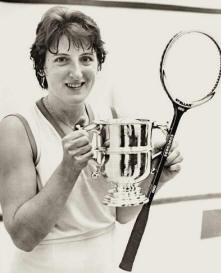 Newman,
born in Sydney in 1950, has enjoyed one of the most
distinguished careers in Australian squash history – as a
player, a coach and as an administrator. Newman,
born in Sydney in 1950, has enjoyed one of the most
distinguished careers in Australian squash history – as a
player, a coach and as an administrator.
She won her first major titles in 1968 when she was crowned
both NSW and Australian junior champion and then went on to
become Australian Amateur Champion in 1975 and 1976, the
first woman to win both the national junior and senior
amateur titles.
She toured Britain and Ireland in the early 1970s, winning a
swag of national titles along the way and reached the final
of the British Open in 1976, where she came up against
McKay.
When McKay retired she seized her chance and claimed the
1978 British Open with a win over Cardwell 9-4, 9-7, 9-2.
Newman captained Australia at the first Women’s World Teams
Championships in 1979 and when she retired from playing she
branched out into coaching and administration, a role she
continues to this day.
Wall, born in Perth in 1948, created sporting history in
1973 when she became the first Australian female squash
player to turn professional.
After she turned professional she was unable to play in
Australian tournaments and she semi-retired from playing
until 1977, when she went to England.
She reached the final of the 1977 British Open final where,
inevitably, she came up against McKay.
After losing that final she returned to Australia and
trained under legendary Australian sprinter Shirley
Strickland, before returning to Europe.
She won the 1978 Irish Open and then went on the claim the
British Open in 1979, downing England’s Sue Cogswell 8-10,
6-9, 9-4, 9-4, 9-3 in the final.
She also played in the 1979 Australian team at the Women’s
World Teams Championships.
|
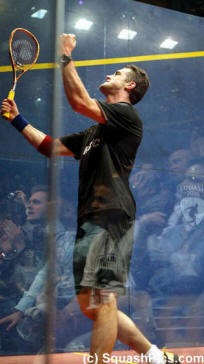
David Palmer is Athlete
of the Year ... again
David Palmer has crowned yet another spectacular year
on the men’s professional squash tour by being named the
Squash Australia Senior Athlete of the Year for the third
consecutive time.
Palmer achieved two long-held goals in 2008, winning his
fourth British Open crown in May then capturing his first
ever Australian Open title in July,
In December he also celebrated 100 consecutive months in the
world’s top 10 – he first broke into the top 10 in September
2000 and has remained there ever since.
Palmer joined the ranks of squash’s greats when he won his
fourth British Open crown with an epic five-game victory
over England’s James Willstrop in Liverpool in May.
The 32-year-old from Lithgow in New South Wales now has more
British Open titles than any other player in the modern era,
including players of the calibre of Peter Nicol, Amr Shabana
and Jonathan Power.
The only men with more British Open titles are the true
legends of the game – Jahangir and Jansher Khan and
Australia’s own Geoff Hunt.
It is a remarkable success story, considering Palmer moved
away from his long-term base in Belgium and away from daily
contact with long-time coach Shaun Moxham at the start of
2008 to set up fresh in Boston.
“It’s been a bit of a transition that’s for sure – I was on
the court with Shaun every day for 10 years and not to have
him there every day was different,” Palmer said.
He was written off as a top contender early in 2008 when he
suffered some early round losses, but he proved the doubters
wrong with his wins in the British and Australian Opens.
He then made two more finals in North America before
reaching the semi-finals of the World Open in Manchester,
where he fell to current world number one Karim Darwish.
He finished the year strongly by reaching the semi-finals of
the rich Saudi International in December and started 2009 in
great style with a win at the Bluenose Classic in
Canada and last week the ISS Canary Wharf Classic in
London.
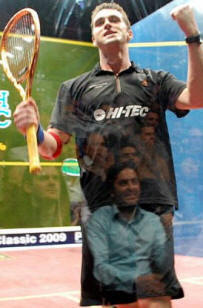
The Junior
Athlete of the Year award went to a player just
beginning his career, 13-year-old Northern Territorian
Rhys Dowling.
Dowling won the boys 13 years division at the Australian
Junior Championships in Perth in September, becoming the
first Northern Territory squash player to win a national
junior championship.
He was also the highest finishing Australian player at the
National Junior Series in Ballarat in March, finishing
fourth in the Geoff Hunt Classic and third at the Sarah Fitz-Gerald
Classic.
“He is a great role model, assisting with coaching of
younger players and always there to help out at junior
fundraising activities,” Squash NT president Steve Armitage
said
“His work ethics is outstanding – attending 96 per cent of
NT Squash Academy training sessions.
“Rhys displays a very positive attitude to competition,
training and off-court activities. His demeanour on the
court is excellent, and he is a willing referee and marker.”
|
 SUE NEWMAN (KING) (OAM)
Date of Birth: April 24, 1950
Born: Sydney
Resides: Sydney (Kogarah)
Sue Newman-King has enjoyed one of the most distinguished
careers in Australian squash history – as a player, a coach
and as an administrator.
Sue’s first contact with squash came when her father built
the Moorefield Squash Centre in Kogarah in Sydney’s south in
1957, and her involvement continues to this day.
But unlike many other children who were brought up in
family-owned squash centres, Sue initially resisted the urge
to play, instead earning pocket money by sweeping the courts
at the end of the day’s play.
“The crazy thing is I didn’t start playing until I was 13,”
she said.
She only picked up a racket when a patron, who had
celebrated a little too freely at the Christmas drinks,
challenged her to a contest to see who could bounce the most
times on Sue’s pogo stick.
“I did about 200 and he fell off after three, so he said
‘come on, I’ll challenge you to a game of squash’, and that
was it.”
From that hit, a future British Open champion was born. Sue
played her first pennant match in 1963 and remarkably has
missed only six pennant competitions since then.
She won her first major titles in 1968 when she was crowned
both NSW and Australian junior champion and then went on to
become Australian Amateur Champion in 1975 and 1976, the
first woman to win both the national junior and senior
amateur titles.
She toured Britain and Ireland in the early 1970s, winning a
swag of national titles along the way and reached the final
of the British Open in 1976, where she came up against
Heather McKay, a player who she had met many times before in
New South Wales competitions.
When Heather retired Sue seized her chance and claimed the
1978 British Open with a win over Vicki Cardwell 9-4, 9-7,
9-2.
Sue captained Australia at the first Women’s World Teams
Championships in 1979 in a team featuring fellow Hall of
Fame inductee Barbara Wall, Rhonda Thorne, Vicki Cardwell
and Anne Smith, and played at the top level for another two
years before turning her hand to coaching and
administration.
She has had a long involvement with US squash and has hosted
many tours from the US as well as organising teams of young
Australians to travel to North America.
Sue has been heavily involved in coaching juniors for the
past 10 years and was current AIS player Scott Arnold’s
coach before he moved to Brisbane.
She currently coaches Andrew Lloyd, the number three ranked
boy in the 15 years age division in New South Wales. Sue was
awarded the Order of Australia in 1999 for services to
squash and the Australian Sports Medal in 2000.
Career Highlights
1978 British Open
1975 Australian Amateur Champion
1976 Australian Amateur Champion
1976 Irish Open
1976 Scottish Open
1973 Welsh Open
1980 South of England Open
Four time NSW Open champion 1975, 1976, 1978, 1980
Two time NSW Amateur champion 1974, 1975
|
BARBARA WALL
Born: May 25, 1948
Birthplace: Perth
Resides: Blue Mountains, NSW
Barbara Wall created sporting history in 1973 and became a
trailblazer for countless others when she became the first
Australian female squash player to turn professional.
Born in Perth in 1948, Barbara learned to play the game in
the squash centre that her parents George and Enid built.
“Dad built one of the first centres in Western Australia
where people could walk in off the street, pay their money
and have a game,” she said.
“Squash was booming back then. In those days you couldn’t
get on a court on Saturdays and Sundays. We had to wait for
someone to be late, and then we’d race down and have a hit.”
Barbara played both tennis and squash as a youngster, but
opted to concentrate on squash because at that time it
offered far more opportunities to travel interstate and play
national tournaments, a big attraction for a teenager living
in Perth in the 1960s.
“It was very exciting in those days to get on a plane and
travel east,” she said with a laugh.
She never really thought seriously of playing squash for a
living and had even semi-retired from the sport in her
mid-20s when she was restricted from playing in Australia
because of her professional status.
During that period she ran a coaching school in Perth and
managed her father’s squash centre, but when she travelled
to Sydney in 1976 to watch the Australian championships, the
British team members told her that professionals could play
in British tournaments and she decided then and there that
that was her future.
“They opened it up which allowed Heather (McKay) to keep
competing because she was turning professional, and I
decided that it was a great way to see the world,” she said.
I’d never been overseas so I came home and I decided I would
sell everything and go to England and play in the
tournaments.”
In 1977 she made the final of the British Open, the first
unseeded player to do so, only to come up against the
formidable Heather McKay in Heather’s last British Open.
“I hadn’t competed for four years and I wasn’t one of the
top players, but I think I got over there and for the first
time in my life I had three months just hitting squash balls
– and I got better and better,” she said.
“Nobody knew who I was and even in Perth people were saying
‘Who’s Barbara Wall?’ I thought nothing better would ever
happen to me in my life -- to get to the final of the
British Open and play Heather McKay.”
However, two years later better things would happen.
The following year she had a minor setback when she went out
to 2007 Hall of Fame inductee Rhonda Clayton (Thorne) in the
quarter-finals, and South African professional Alan Colburn
told her that he thought she would go back to Australia with
her talent unfulfilled.
“He was a wonderful pro and he did some work with me, but he
said I would never know how good I could have been -- I
would never realise my true potential,” Barbara said.
With those words ringing in her ears, Barbara returned to
Australia and contacted Australian track and field legend
Shirley De La Hunty (Strickland), who spent almost 12 months
helping her with her fitness training and her speed work.
She went back to England and went on to win the title in
1979, downing England’s Sue Cogswell 8-10, 6-9, 9-4, 9-4,
9-3 in the final .
“It was the most wonderful thrill to win it – you dream of
it, but you never dream it will happen really,” she said.
Barbara still regards that win as the highlight of a
glittering career, which also includes winning the Irish
Open, the Belgian and Danish Opens and the South African
Champion of Champions.
She was also chosen in the Australian team for the first
ever Women’s World Team Championship in 1979 alongside
Rhonda Clayton, Vicki Cardwell, Sue King and Anne Smith,
where they finished second to a combined Great Britain team.
She said being inducted into the Hall of Fame, after nearly
20 years away from the sport, was a huge honour for her.
“It’s not just about winning the British Open – it’s about
my whole life in squash, and for 35 years it was my life.”
Career Highlights
1979 British Open
1978 Irish Open
1979 South African Champion of Champions
1979 NSW Open
Four time WA champion – 1969, 1970, 1971, 1979 |
|


